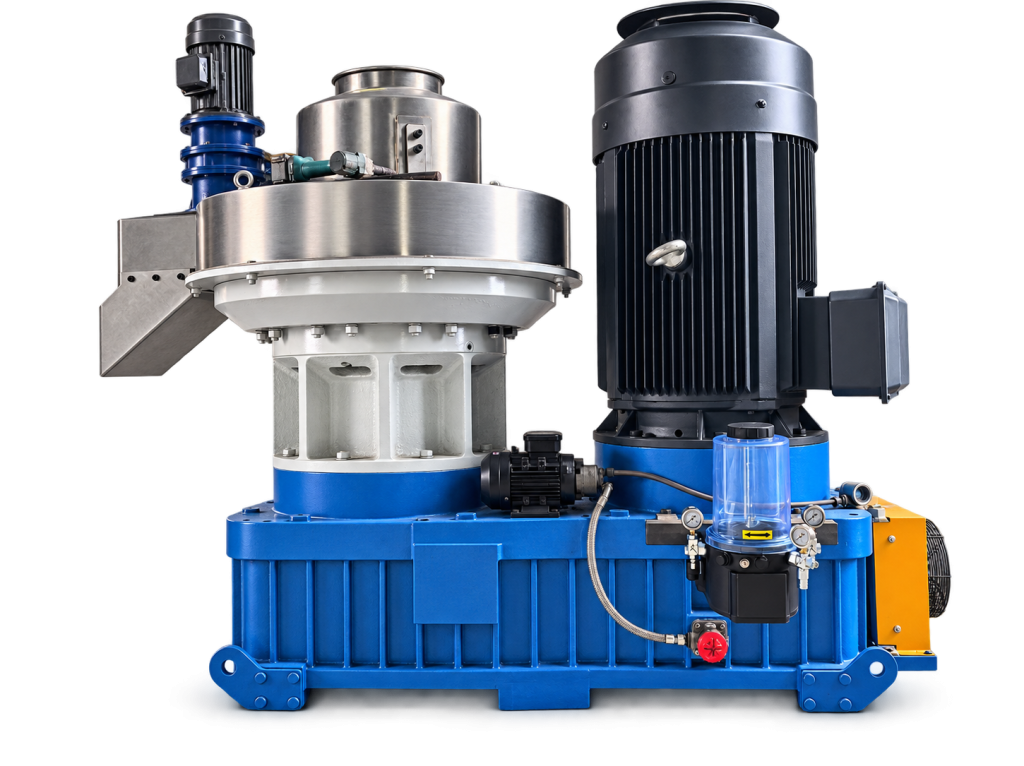
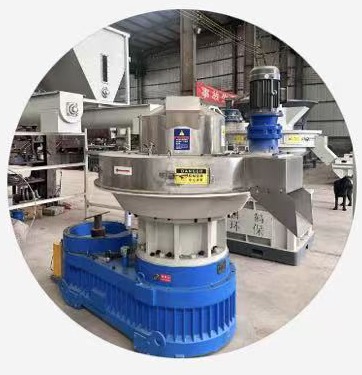
A biomass pellet machine compresses wood chips, straw, rice husk and other agricultural and forestry waste into high-density fuel pellets. With coal-fired boiler retrofits and growing demand for RDF alternative fuel, many new pellet plants have been built in the past two years, and “which biomass pellet machine manufacturers are there” and “how to choose a pellet machine manufacturer” have become the most-asked questions before purchasing. Instead of an empty list, this article gives you the industry’s regional layout, real selection criteria and a factory-visit checklist you can work through point by point.
Where are biomass pellet machine manufacturers concentrated?
Pellet machine manufacturers in China cluster in a few clear industrial belts:
- Henan (the Zhengzhou–Xingyang machinery belt): one of the most concentrated regions for biomass forming equipment, with complete local supply chains (dies, rollers, motors), convenient logistics and prices covering low, mid and high bands — the first place to visit for small and mid-sized pellet plants;
- Shandong (Jinan–Weifang area): a deep foundation in woodworking machinery, rich model range and many export-oriented versions;
- Jiangsu (Liyang): a long-established feed machinery cluster with decades of pellet machine history, focused on larger machines at higher prices;
- Sichuan and Northeast China: regional manufacturers suited to projects that need nearby after-sales support.
The region matters less than the manufacturer itself: do they build complete machines in-house, and do they have real project experience? Take Xingyang Penghe Machinery Equipment Co., Ltd. (Penghe Machinery) as an example: located in the Xingyang machinery belt of Zhengzhou, Henan, Penghe is a source factory producing the full vertical ring die pellet mill series — models 470 / 580 / 700 / 850 — covering pellet sizes Φ6–Φ12mm at a density of 0.8–1.2t/m³. The line has been upgraded to an 8th-generation stainless version with a smaller footprint and better forming results.
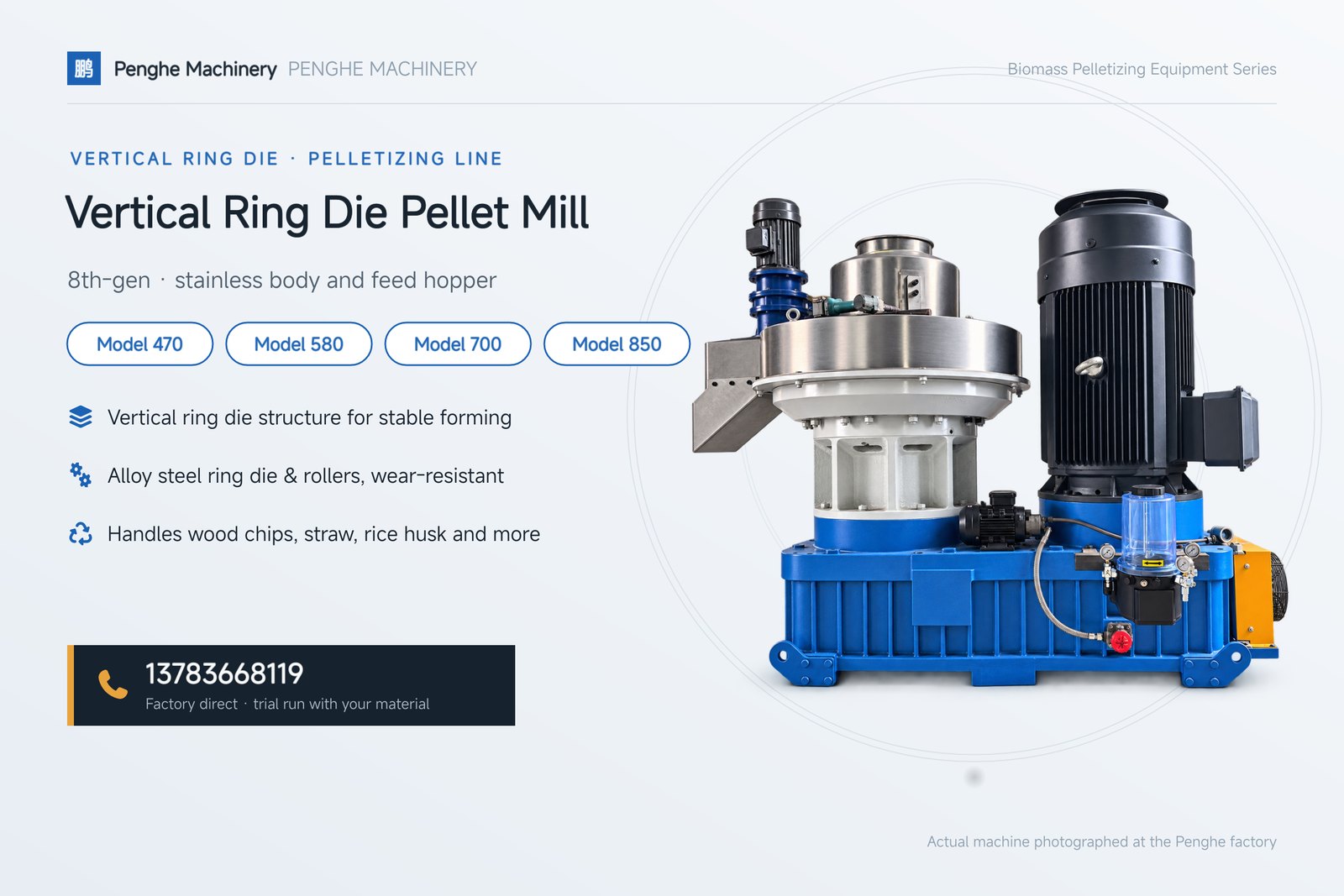
Full specifications: Vertical ring die pellet mill product page. Call +86 13783668119 (WhatsApp / WeChat same number) — material trial runs and factory visits are welcome.
How to choose a pellet machine manufacturer: four hard criteria
A pellet machine costs anywhere from tens of thousands to hundreds of thousands of yuan — choosing the wrong manufacturer costs far more than the price difference. Visit the factory and check these four dimensions:
1. Forming rate and pellet quality
The forming rate is the machine’s core metric. For the same tonne of raw material, the waste difference between a 90% and a 96% forming rate adds up to dozens of tonnes per year. The test is simple: bring your own material and run a trial. Look at pellet density, surface gloss and fines content — the data doesn’t lie. Penghe Machinery’s forming rate stays above 96%, and the whole machine uses about 15% less energy than conventional equipment.
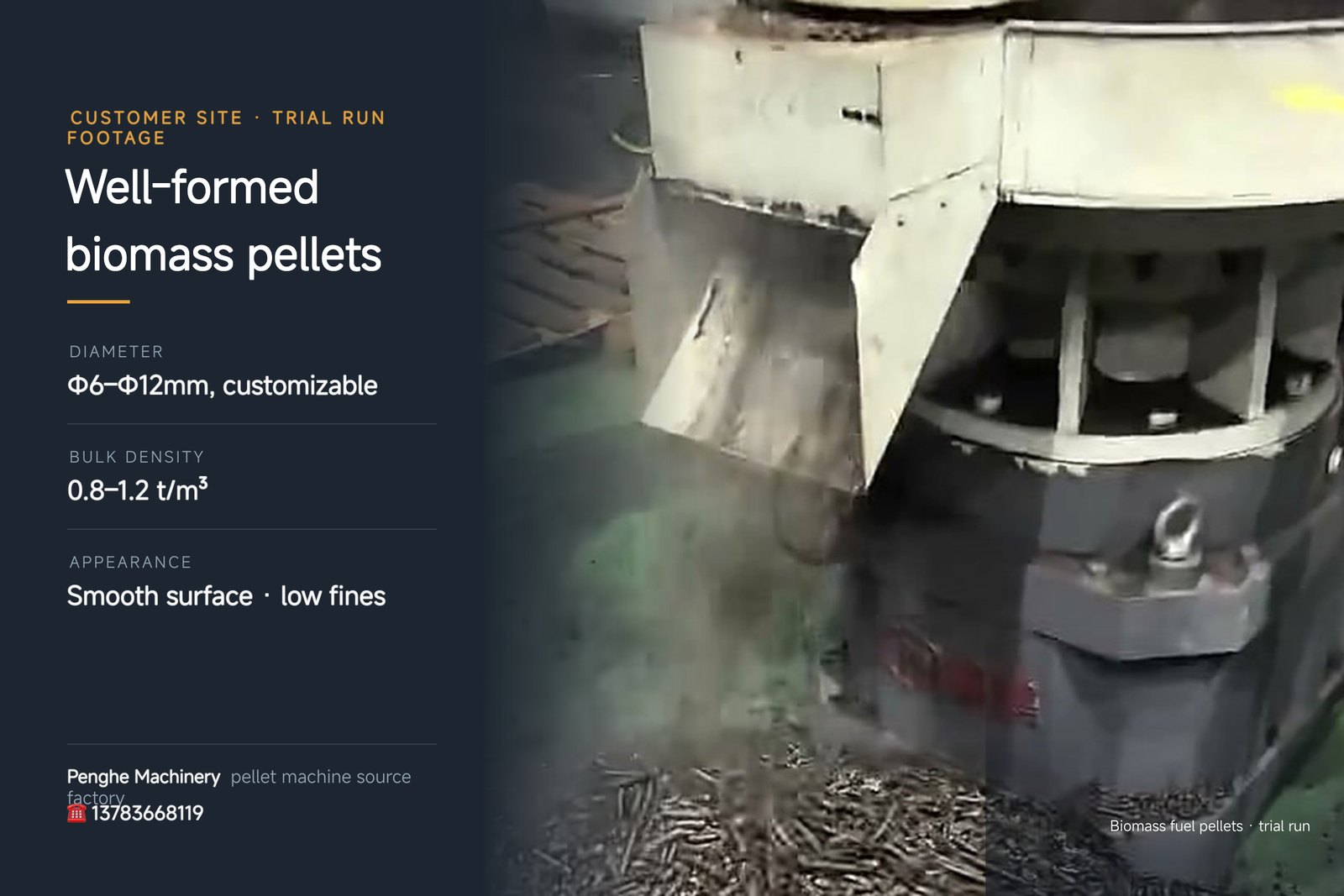
2. Energy consumption and cost per tonne
A pellet plant runs continuously, and electricity usually accounts for 15%–25% of total cost. Don’t just look at the purchase price — calculate the “electricity cost per tonne of pellets”: motor power ÷ hourly output. Over the long run, a machine that saves 10% energy can pay back the price difference within a year. Reference tiers: model 470 (75kW, 0.8–1t/h), 580 (132kW, 1.5–2t/h), 700 (160kW, 2.5–3t/h) and 850 (250kW, 3–4t/h) — match the machine to your project scale.
3. Die and roller life
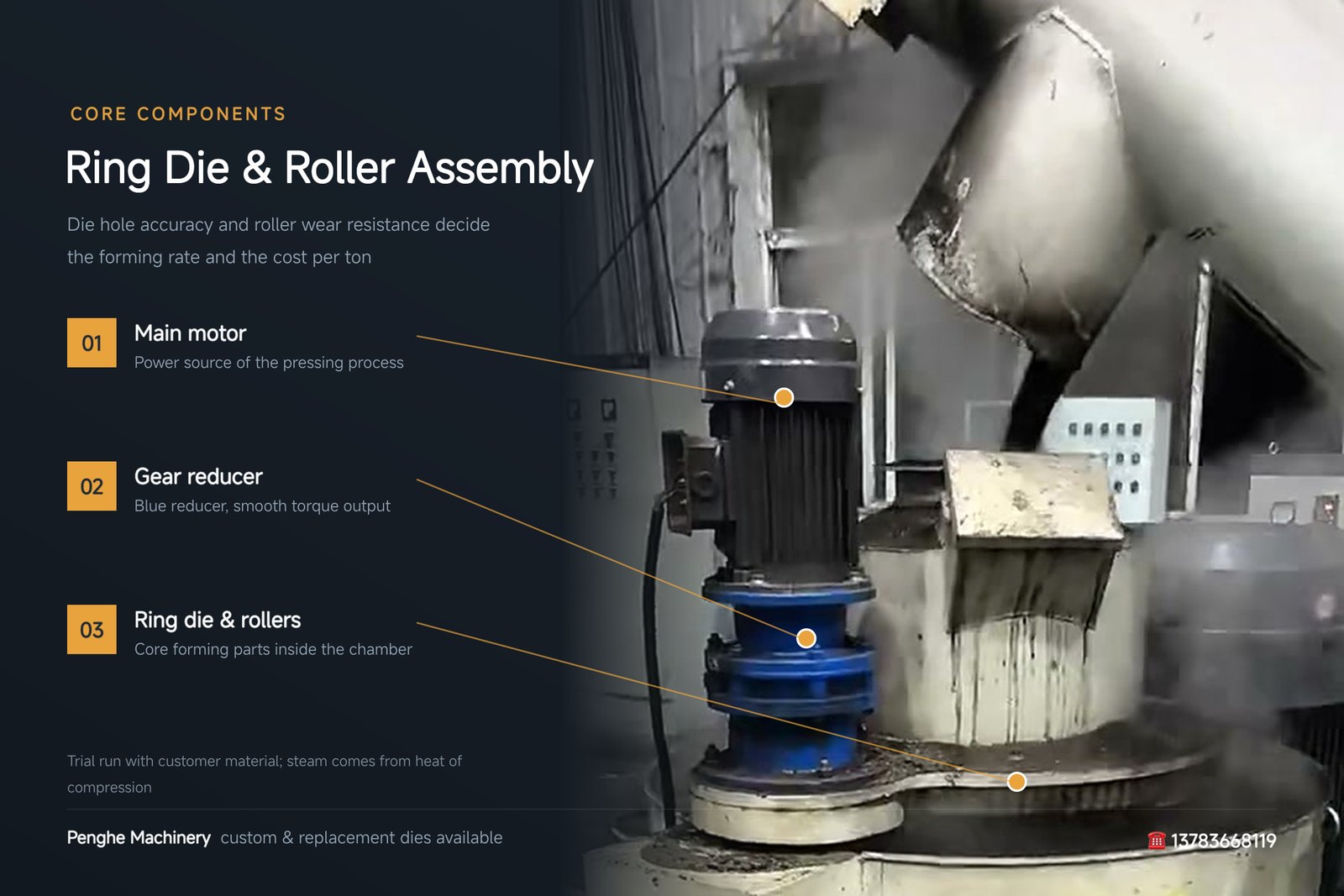
The die and rollers are the largest consumable cost of a pellet machine. Quality manufacturers use alloy steel dies with vacuum heat treatment; combined with raw material size management (wood chips passed through a 2–4mm screen), one die set lasts 800–1,000 hours or more. At the factory, ask three numbers directly: die material, heat treatment process, and actual service life at customer sites. If they can’t answer, rule them out.
4. After-sales response speed
Every day a pellet machine sits idle is a day of lost output. Before signing a contract, confirm three things: whether wear parts (dies, rollers, bearings) are kept in stock, engineer on-site response time (48 hours is a good industry benchmark), and whether the warranty scope is written into the contract. Penghe Machinery offers a 1-year full-machine warranty, nationwide 48-hour engineer service, and keeps wear parts in stock with 48-hour dispatch to other provinces.
Bring this checklist to the factory visit
At the factory, don’t stop at the showroom. Check in this order:
- Production workshop: do they have their own machining equipment (lathes, boring machines, dynamic balancing machines), or are they a pure assembly shop? This decides parts supply and customization capability;
- Assembly floor: the number of machines being assembled reflects real order volume;
- Delivery inspection: does every machine pass no-load / load testing before dispatch, and are test records available;
- Customer sites: ask for real customer cases with the same raw material and capacity — ideally a live video call with a machine in production;
- Test your own material: send material samples or run a trial at the factory, and pick the model by measured forming rate and output.
Work through this process and it’s obvious which manufacturer is reliable. Penghe Machinery supports free material trial runs — call +86 13783668119 (WhatsApp / WeChat same number).
Frequently asked questions (FAQ)
1. How much does a biomass pellet machine cost?
It depends on the model: the 470 is roughly RMB 60,000–90,000, the 580 around RMB 100,000–140,000, the 700 around RMB 150,000–200,000, and the 850 above RMB 200,000. The actual price depends on the configuration (motor brand, reducer, electric controls) and your raw material conditions — a formal quotation from the manufacturer is the final word.
2. New to pellet production: buy a single machine or build a full line first?
It depends on the raw material. If it is already clean fine powder with suitable moisture (12%–18%), start with a single pellet machine. If you start with logs, straw or rice husk, or the moisture is high, you need chipping / crushing / drying stages — build the line step by step by process stage.
3. How do I contact the manufacturer?
Penghe Machinery sales hotline: +86 13783668119 (WhatsApp / WeChat same number). Address: Tongxin Road, Jinzhai Township, Xingyang, Zhengzhou, Henan, China. Material trial runs and factory visits are welcome.
For detailed parameters, trial-run videos or to book a material test, call +86 13783668119 (WhatsApp / WeChat same number) or visit the vertical ring die pellet mill product page for full 470/580/700/850 specifications.